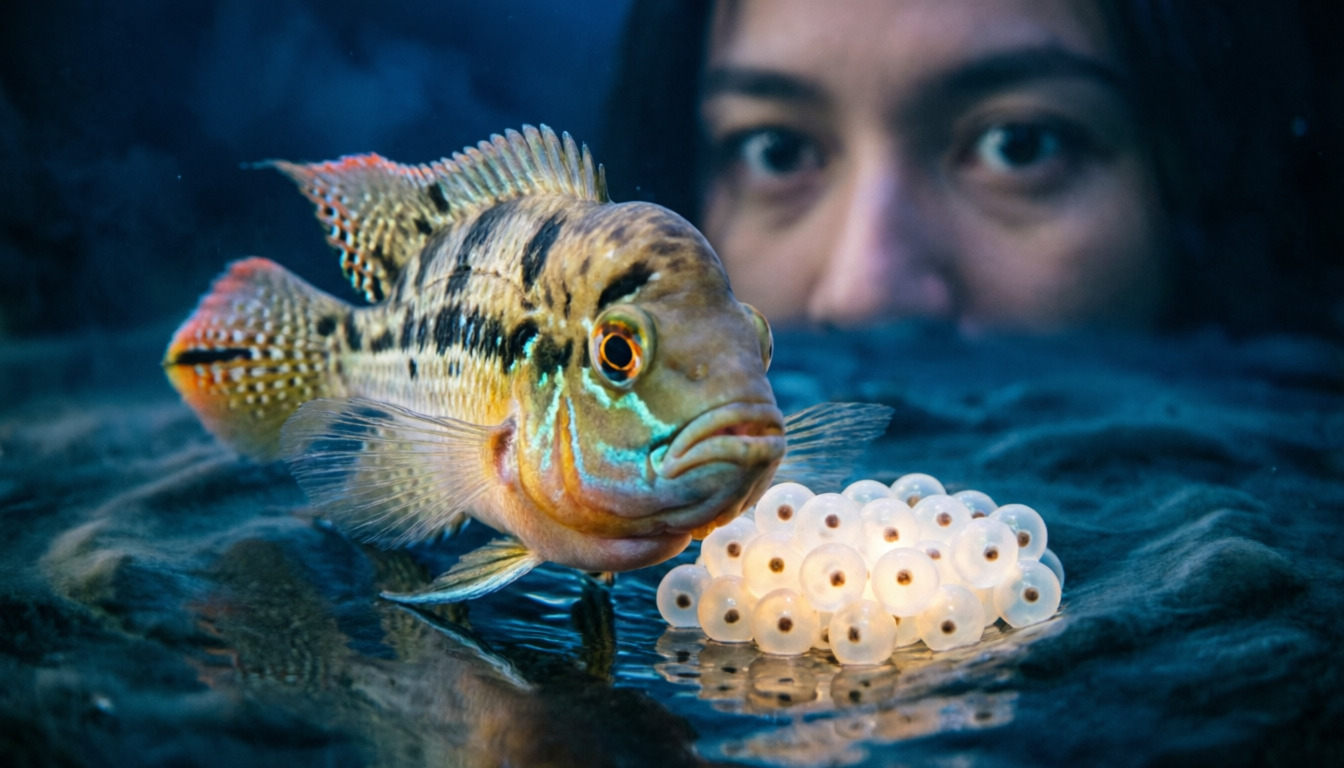
We have always treated the natural world as a museum, and ourselves as its invisible patrons.
When we peer into an aquarium or drift above a reef, we carry a quiet assumption: that our attention passes through the world without consequence. That we can look without being part of what unfolds.
But some systems do not permit that illusion.
Observations of the Emperor cichlid — a fiercely protective fish — reveal something difficult to ignore. When a human approaches, the fish does not simply react to movement or shadow. It tracks something subtler.
If the observer's gaze wanders, the fish remains alert but steady.
If the observer's eyes fix on its eggs, the response changes immediately. Defensive behavior rises — sharply, measurably.
The fish is not reacting to contact. It is responding to a line that cannot be seen: from a human retina to its offspring.
This requires something precise. Not reflex. Not simple stimulus-response.
The fish is modeling attention. It understands, in its own way, what it means to be looked at — and what that looking implies.
It carries direction. It carries implication. It carries weight.
We tend to think of observation as passive, as the quiet gathering of information. But in systems sensitive enough to register it, observation begins to act. Not metaphorically. Structurally.
The system reorganizes under the gaze.
We are beginning to see the same pattern in places far removed from aquariums.
At the smallest scales, and in the most delicate measurements, the act of observation cannot be separated from what is observed. In certain physical and biological systems, the method of inquiry shapes the outcome itself.
Too much force, and the signal simplifies. Too much insistence, and the system complies. What appears as "data" is often not the system as it was, but the system as it could remain under the conditions imposed upon it.
The cichlid does not need quantum theory to know this. It feels the pressure directly.
What emerges across these domains is not a single mechanism, but a shared condition. Systems that can respond do not simply reveal themselves. They adjust to the way they are engaged.
but what our way of looking allows to remain.
There may be a limit to what can be known through force. Beyond that limit, increasing clarity does not come from sharper tools or stronger probing. It comes from changing the nature of attention itself.
Not removing the gaze — but refining it, until it no longer collapses what it seeks to understand.
The cichlid has already adapted to it.
The rest of us are still learning how to look.