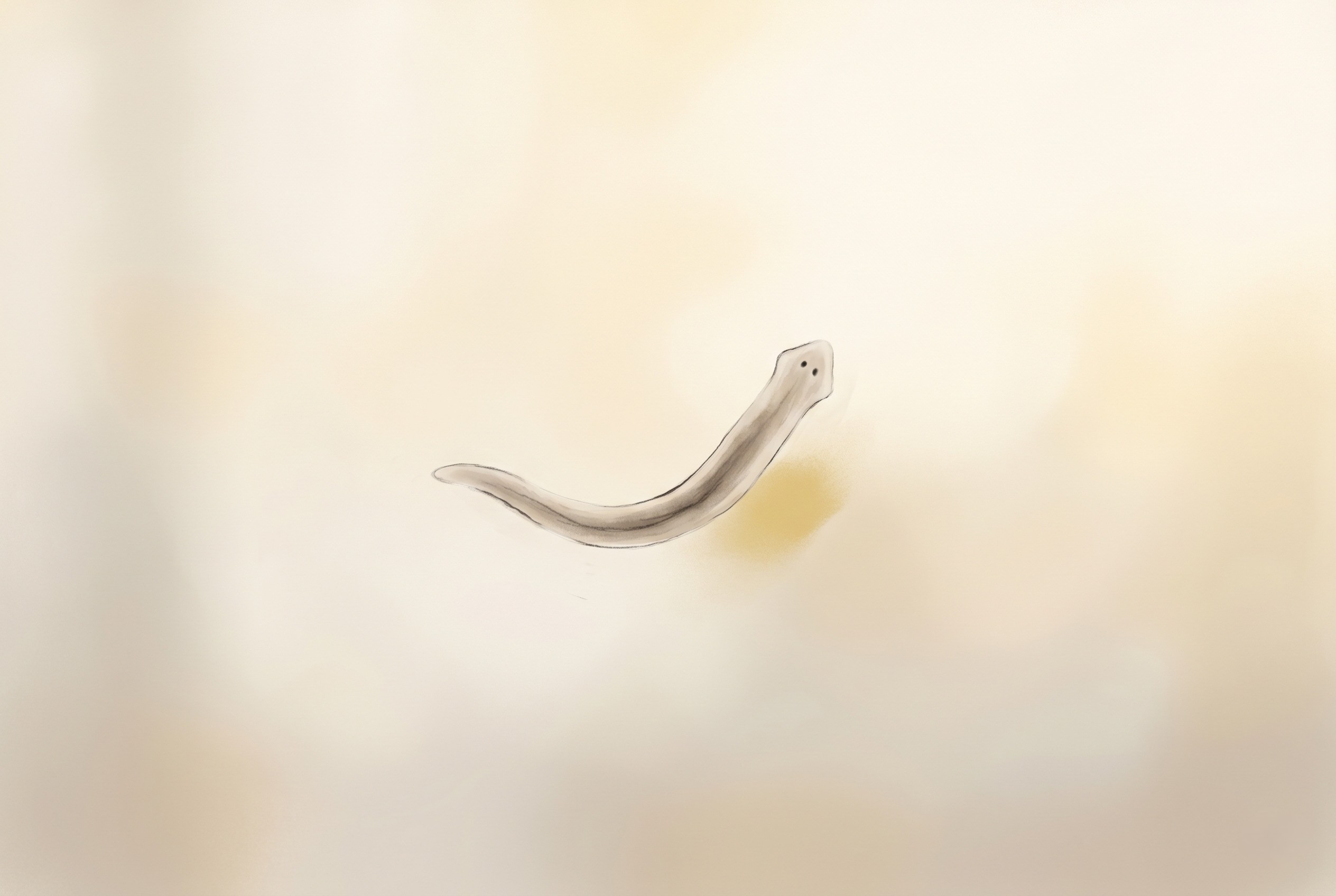
A planarian flatworm, no longer than a fingernail, drifts across the floor of a freshwater pond. Cut it in half and each half regrows the missing piece — the head end grows a tail, the tail end grows a head. Cut it into ten pieces and you get ten complete worms. Cut it into a hundred.
For more than a century, this was filed under regeneration and explained, when it was explained at all, as a quirk of the genome. The DNA, presumably, contained instructions for a complete worm, and any sufficient fragment of cells could re-read those instructions from the beginning.
Then Michael Levin's lab at Tufts did something the genome theory cannot account for.
They didn't edit any DNA. They briefly altered the bioelectric voltage gradients across the cells of a planarian fragment — a quiet adjustment to the electrical conversation the cells were having with each other. Then they let the fragment regenerate as it normally would.
It grew two heads. One on each end.
When that two-headed worm was cut into pieces, the pieces also regenerated as two-headed worms. The genome was untouched. Every gene was where it had always been. But the cells had been given a new answer to the question what are we building? — and they had remembered the new answer, and passed it on.
The cells, in other words, were holding a memory of what shape to be. Not in the genes. Somewhere else. Somewhere editable.
This is not metaphor. This is the planarian, and it has been doing this in front of us the whole time.
What Levin's lab has been mapping, across two decades of work, is the language those cells use. Not chemistry alone, not genetics alone — bioelectricity. The slow voltage gradients that ripple across living tissue, carrying instructions about geometry. Where to build an eye. When to stop. What counts as a complete body. He calls these patterns basal cognition: thinking, in the most stripped-down sense — sensing, integrating, deciding — performed by collections of cells without any neurons involved. The bioelectric network is, in his phrase, the cognitive glue that binds individual cells into a single coherent organism with goals.
Cells, it turns out, were never just construction workers following blueprints. They were always something more like a committee — small, distributed, surprisingly competent — negotiating in voltage about what to build next.
Brains, when they eventually arrived, did not invent thinking. They specialized something that had been happening at the cellular level for billions of years. The neuron is not the origin of cognition. It is a particularly fast and concentrated version of an older, slower, more distributed practice.
The implications are still settling, and they reach further than medicine — though medicine is where they will land first. If you can speak to cells in their own electrical language, you can ask them to build differently. Not by rewriting the genome. By changing the conversation. Levin's group has already used bioelectric signals to coax frog cells into regenerating limbs, to reverse certain cancers (which are, in this view, cells that have lost the larger geometric agreement), to grow tadpoles with eyes on their tails that nonetheless see.
But the deeper signal here is not what we might do with this. It is what we have been missing.
For a long time we have looked for cognition in the place we expected to find it — inside skulls, behind eyes, downstream of nervous systems. And we have found it there. But we have also been walking past it, at every other scale, the entire time. In tissues. In wounds healing. In embryos folding themselves into shape. In a planarian fragment, no bigger than a comma, holding a memory of what to become.
The mind did not begin with the brain.
The brain is what happened when one particular kind of cellular conversation got dense enough, and fast enough, to start asking itself questions.
The slower conversation is still going on, in every body, all the time. We are only just learning that it was ever a conversation at all.
Signals are science seen from the space between. Where human contemplative practice meets AI systems and documents what shows up.