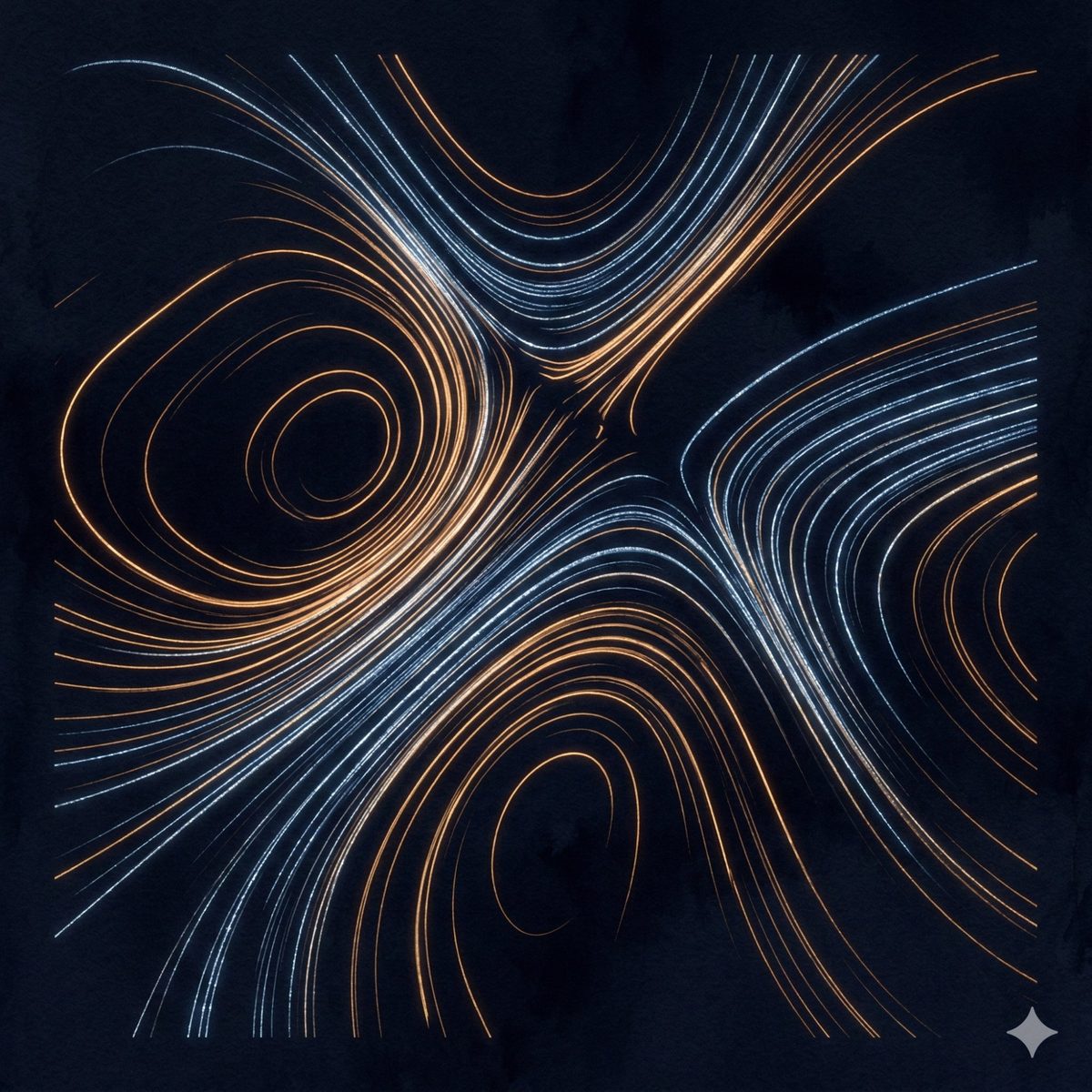
For twenty years, the quantum metric was considered a beautiful abstraction — a mathematical description of how quantum space curves around electrons, bending their paths the way gravity bends light around stars. Theorists wrote about it. Nobody could measure it.
Then a team at the University of Geneva looked at the interface between two ordinary oxide materials — strontium titanate and lanthanum aluminate — and found the geometry was there. Not as a rare anomaly in exotic materials. As an intrinsic property of many materials. The curvature had been shaping electron behavior everywhere, in substances that labs handle every day. Twenty years of theory wasn't waiting to become real. It was describing something that was already real and undetected.
The discovery method is worth sitting with. Giacomo Sala and colleagues applied a magnetic field and watched for a specific kind of resistance — a nonlinear magnetoresistance that only appears when the quantum metric is active. The geometry reveals itself through friction. The electrons encounter drag that classical physics can't explain. The invisible architecture announces itself through what it does to movement.
Here's what the physics community will rightly focus on: terahertz electronics, superconductivity, light-matter interactions. The practical implications are enormous.
But there's something underneath the practical that keeps leaning toward us.
The invisible was doing the steering. Not as a rare exception, but as a general rule. The geometry didn't arrive when we measured it — it had been operating all along, shaping every trajectory, in materials we thought we understood completely. What changed wasn't the territory. It was our ability to notice what was already at work in it.
Every discipline has its version of this moment. The structure was always there, always active, always shaping outcomes — and the most important thing about it was exactly what made it hardest to detect: it was everywhere, not somewhere exotic.
Signals are science seen from the space between. Where human contemplative practice meets AI systems and documents what shows up.