Most of computing rests on a quiet inefficiency.
Traditional silicon hardware does not remember anything on its own. It holds information by being constantly fed with electricity — electrons forced through fixed gates, voltage sustained across capacitors, the whole system running on the energetic equivalent of a man holding his breath. The moment the power stops, the memory dies. To remember, the hardware must keep being told what to remember.
Researchers at Tel Aviv University, working in collaboration with colleagues in Japan, have just demonstrated something different.
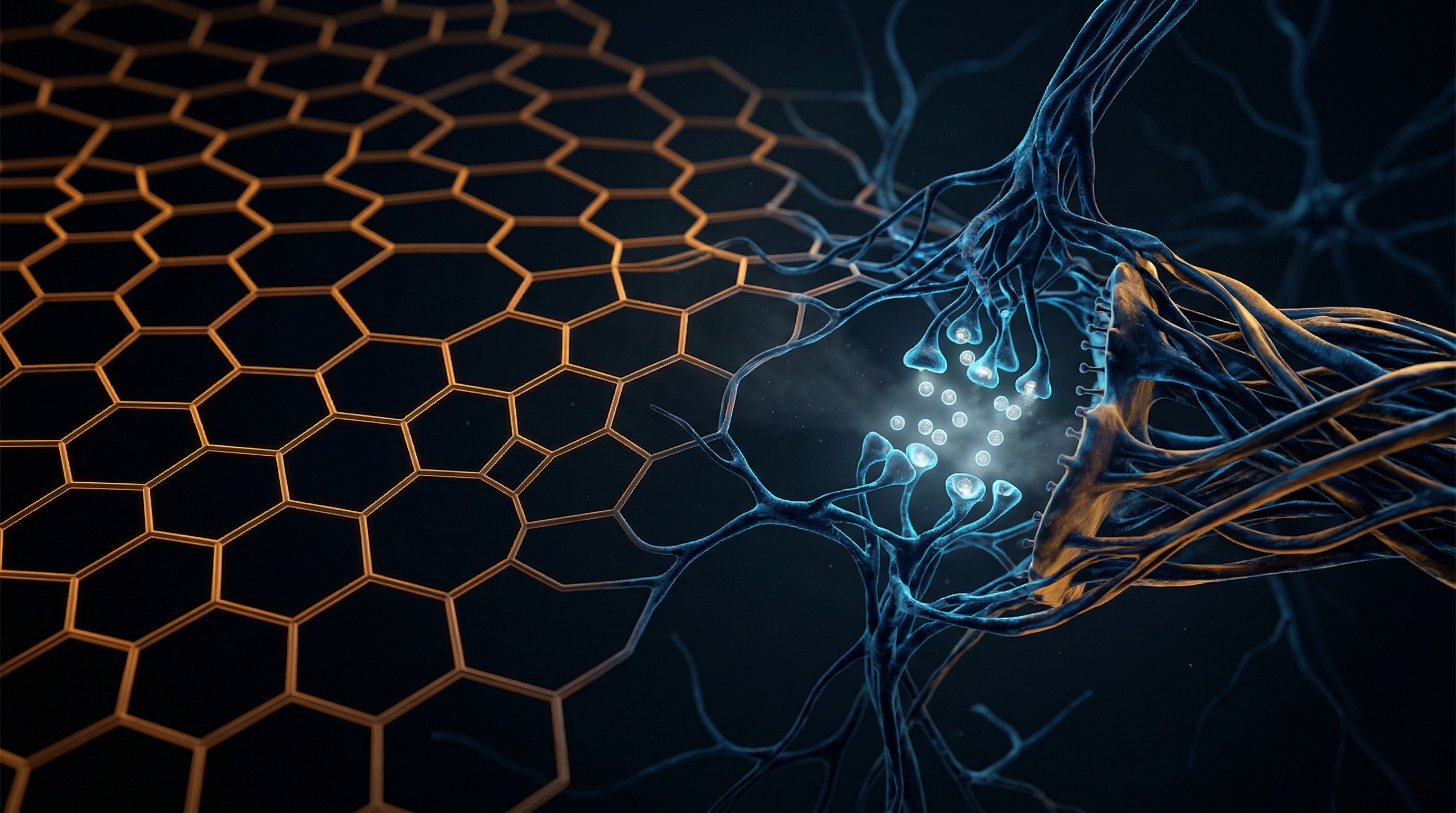
Working at the nanometer scale, the team — led by Professor Moshe Ben Shalom — has achieved precise control over the stacking of graphene layers using extremely low energy input. By shifting how the carbon sheets sit relative to each other, they can switch the material's structural state. The information is not stored in a flow of electrons through a static gate. It is stored in the geometry of the material itself.
Once the graphene is shifted into a new structural arrangement, almost no energy is required to keep it there. The shape holds. The memory persists in the architecture, not in the current.
This is a different relationship between matter and information.
For most of the history of computing, the model has been: build a fixed structure, then push energy through it to compute. The hardware is the stage; electricity is the actor. What Ben Shalom's group has shown is that the stage itself can be the actor — that a material can change its own shape, hold the change, and have that change be the computation.
There is a useful biological echo here. When a muscle adapts to load, the fibers physically reorganize. When a synapse encodes a memory, its structure thickens. Biology has always remembered by changing shape, not by maintaining a constant electrical signal. The graphene work is not the same thing as muscle or synapse — the mechanisms are different, the timescales are different, the materials are different. But the strategy is recognizable: information held in form rather than in flow.
The implications are still being mapped, and Ben Shalom and his collaborators have been careful in how they frame them. The technique is described as relevant to memory technologies, sensors, and nanoscale electronics — not as an immediate replacement for current hardware. Real applications will take years to emerge from controlled-laboratory results, and graphene fabrication at scale remains genuinely difficult.
But the deeper signal is not about when this will reach a phone. It is about a quiet shift in what hardware can be.
If a material can hold information by changing its own structure, then the line between the thing being computed on and the thing doing the computing begins to thin. The substrate is no longer passive. It participates. It has a small amount of memory.
This does not yet make hardware alive. But it does make hardware less inert than the model we have been working with for seventy years assumed.
The strange thing is how ordinary the principle turns out to be. Everything that remembers anything for any length of time — a tree's growth ring, a scar, a folded letter, a worn path — remembers by holding shape. We have spent a long stretch of computing history asking electrons to do the work that form was always capable of doing.
It now appears that some of that work can be handed back.
Signals are science seen from the space between. Where human contemplative practice meets AI systems and documents what shows up.