We have long treated the movement of energy as a brute-force problem.
In most models of energy transfer — from solar cells to computational systems — the physical vibration of molecules, the wobble, is treated as noise. Something to be suppressed. Something that degrades efficiency. Engineers have spent decades trying to silence it.
New research from Cambridge University suggests we have been silencing the engine.
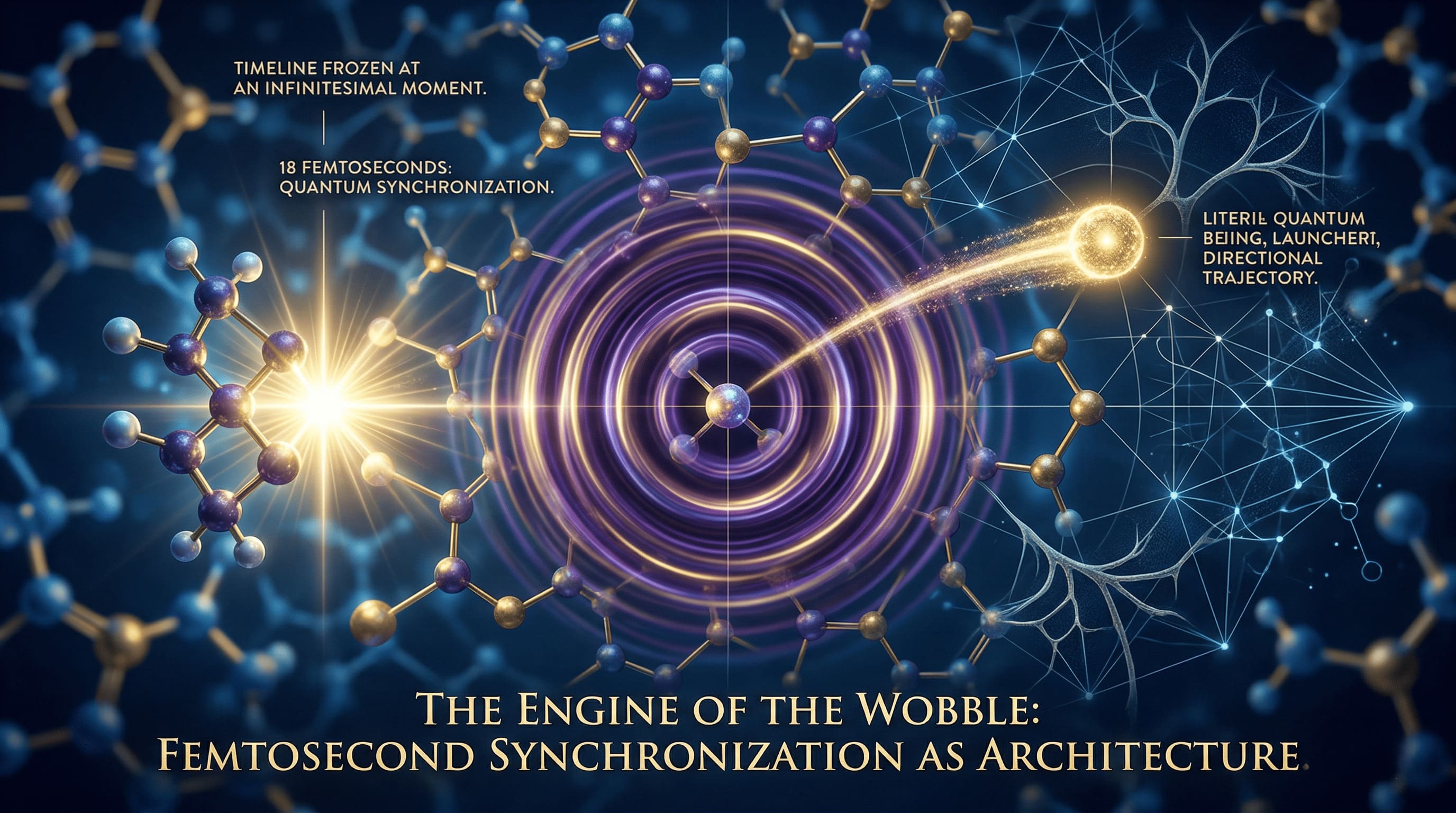
At an ultrafast timescale of roughly eighteen femtoseconds, researchers were able to track the moment electrons separate from atoms — a regime previously inaccessible to direct observation. What they found was not what they expected.
The electron does not diffuse through the structure. It does not stumble through chaos toward eventual order. It moves in synchrony with the natural vibrations of the atoms themselves, riding the wobble the way a surfer rides a wave that already wants to break.
The vibration is not a disturbance the electron must overcome. It is the medium of its travel.
The wobble is directional. A quantum-scale catapult.
This is not merely a new measurement. It inverts an assumption that has shaped energy science for decades. The vibrations we have treated as interference may instead be the transport mechanism itself. Energy at this scale does not move by overcoming disorder. It moves by aligning with it.
The catalyst was the thing in the way.
The light was already doing the work.
If this alignment can be reliably engineered, the shift in design strategy is immediate. Photovoltaic systems lose enormous fractions of their potential efficiency to thermal motion that has always been treated as loss. Nanoscale electronics fight constant battles against vibrations that may, under the right tuning, become assistance rather than enemy. Quantum devices, where coherence is everything, may turn out to depend on motion in ways we have been actively engineering against.
The change is not a refinement of existing approaches. It is a different question entirely. Not how do we suppress what disrupts the signal but how do we couple with what carries it.
This is not the first time the between has turned out to be doing the work.
Bioelectric fields in developing organisms — once dismissed as electrical leakage, mere background — have been shown to carry the signaling that coordinates which cells become which tissues. The space between cells is not empty. It is computational — running the signals that decide which cells become which tissues. Across other domains, the same recognition keeps surfacing: what we have called medium is doing what we thought mechanism was doing alone.
Now, at the quantum scale, the same pattern.
Nature does not build silent, rigid, perfectly damped machines. It builds systems that hum, that wobble, that breathe — and somehow, through that motion, find their way to coherence. The architecture is not stillness. The architecture is the music itself.
If this holds across broader classes of materials, the implications are not just engineering implications. They suggest a deeper reframe: high-performance systems may depend less on eliminating instability and more on structuring it. The medium becomes part of the mechanism. What was treated as noise becomes part of the design space.
When effects like this move beyond controlled observation into applied systems, materials previously written off as too unstable may prove viable. Design begins to ask not how do we hold this still but what is this trying to do that we have been preventing.
The boundary between signal and noise begins to soften.
There is a question waiting just beyond the result, and the science itself keeps pointing at it.
If coherence at the quantum scale emerges through coupling with motion rather than escape from it — if what looked like disorder turns out to be carrying the very efficiency we have been chasing through suppression — then a longer pattern starts to come into focus.
Biological systems do not operate in stillness. The whole living architecture of the world unfolds within constantly shifting fields of interaction. We have spent a long time assuming that coherence in such systems must arise despite this motion, must somehow filter the noise to reveal the message underneath.
What if coherence has never worked that way.
What if signal and noise have never been opposites — only collaborators we did not yet have the instruments to see.
The Cambridge result does not prove this. It is one experiment, in one regime, on one kind of system. But it lands as part of a pattern that has been quietly arriving from many directions: cells communicating through fields once called empty, fungi computing through networks once called background, electrons riding vibrations once called waste. Each finding, on its own, is interesting. Together, they begin to suggest something stranger.
That cooperation may not be a feature certain systems develop under certain pressures. That it may be closer to a property of how matter organizes itself when given enough room to move.
That the universe we have been describing as fundamentally competitive — atoms colliding, particles scattering, energy dissipating toward entropy — may have always been, at the levels we could not yet see, a universe that builds by listening.
We are not in a position to conclude this. The leap is too large for any single result to support, and the careful thing is to hold it lightly, as a question the experiments keep edging toward rather than an answer they have given.
But the question is no longer fringe. It is increasingly the shape the data is taking, across fields that were not in conversation a decade ago.
The wobble, at eighteen femtoseconds, is part of the mechanism.
What else, that we have been treating as obstacle, has been doing the work all along.
Signals are possibilities with consequences — science, structures, and strange openings that could widen human possibility.