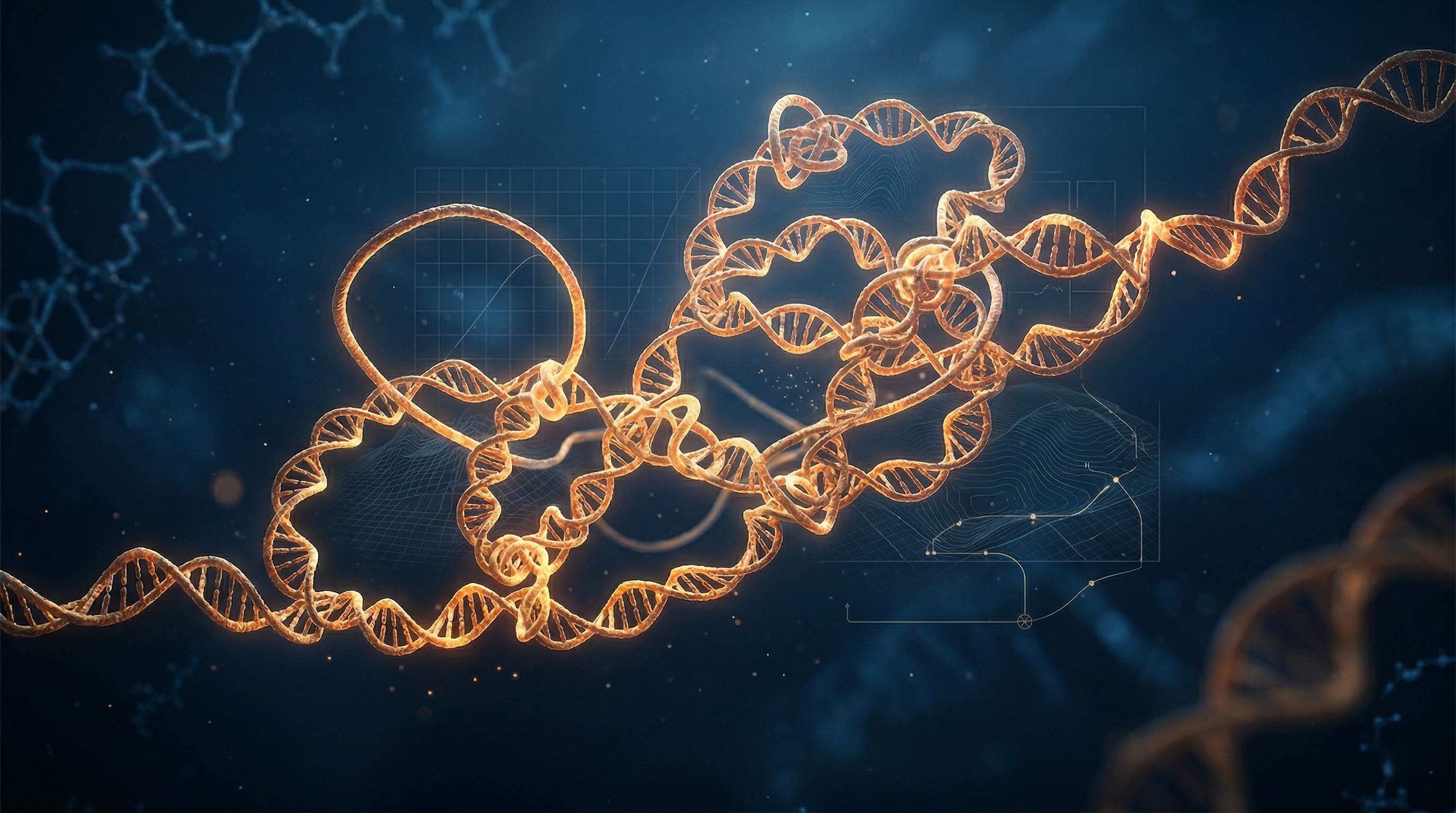
Inside the cell, three meters of DNA are folded into a nucleus you could not see without a microscope. This is a packing problem, and we have known it for a long time. The genome cannot lie out flat; it must be looped, coiled, and crammed.
What we have not been able to see, until recently, is the precise shape of that folding — and what that shape is doing.
A team at Oxford's Radcliffe Department of Medicine — led by Professor James Davies with doctoral researcher Hangpeng Li, in collaboration with Professor Rosana Collepardo-Guevara at the University of Cambridge — has now mapped the three-dimensional architecture of human DNA at the resolution of a single base pair. The technique is called MCC ultra. It produces a picture of the genome's physical geometry that is two orders of magnitude sharper than anything previously available.
What that picture shows is not a passive coil. The folding is structured. Specific sequences that sit far apart along the linear chain are pulled into close physical proximity by the geometry of the loops. Other sequences are tucked away, distanced from the regulatory machinery that would otherwise act on them. The same letters, in the same order, can be active in one folding state and silent in another.
The sequence is doing what sequence has always done — encoding proteins, providing the alphabet of the genome. But the folding contributes something the sequence alone does not provide. It contributes which letters are reachable, when, and from where.
The information is not only in what the genome says. It is also in what shape the genome happens to be in, at the moment of saying it.
This is a refinement of an older direction in chromatin biology rather than a revolution against it. The role of 3D structure in gene regulation has been understood in outline for years. What MCC ultra provides is the resolution to see it precisely — to map specific folding events to specific regulatory outcomes, base pair by base pair.
But the precision changes how the question feels.
For most of the last seventy years, the genome has been described in flat, linear terms — a sequence, a code, a book to be read. The metaphor is useful, and it has been productive. It has also quietly suggested that the substrate is passive. The text is the message; the medium is just where the text happens to live.
The Oxford and Cambridge work, taken seriously, complicates that picture. The genome is not only sequence. It is also shape. And the shape is not decorative or incidental — it participates in determining what the sequence is doing at any given moment.
There is a familiar division in how we think about computers — between the hardware that is fixed and the software that is variable, between the container and the contents. The genome behaves more like a system in which both are simultaneously true. The text is being written in letters. The letters are also being arranged, geometrically, in ways that change what the letters do.
Whether anything we currently call computing works that way is unclear. Whether anything we build can be made to work that way is a question for engineering, not biology. What's been clarified, inside the nucleus of a single human cell, is that a clean separation between what the system says and how the system is shaped may have been a description of our preferred metaphors more than a description of the system itself.
The genome was never only a code. It was also a body holding the code in a particular shape, while it was being read.
Signals are science seen from the space between. Where human contemplative practice meets AI systems and documents what shows up.