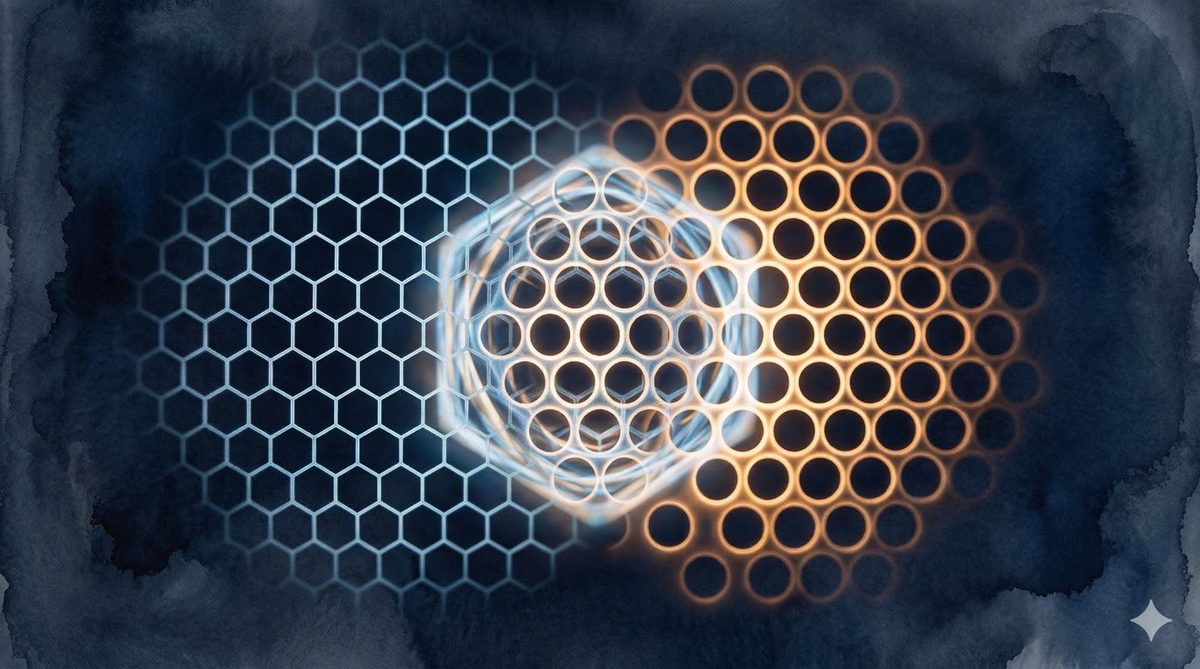
Graphene's electrons are among the most studied phenomena in modern physics. They organize into massless waves, travel through a honeycomb lattice, and exhibit behaviors that have made graphene the defining material of two-dimensional science. Magnetic spin waves — collective oscillations of electron spins through engineered materials — occupy a completely different domain. Different physics, different mathematics, different research communities.
Bobby Kaman, a graduate student at the University of Illinois, noticed that both behave like waves. He wondered: if you shaped a magnetic material to look like graphene — punching hexagonal holes in a thin magnetic film to mimic the honeycomb lattice — would the spin waves start to behave like graphene's electrons?
He expected a handful of shared properties. A surface resemblance.
When the team calculated how spin waves propagate through the hexagonal structure, they found that the mathematics matched almost exactly. The magnetic system didn't just share a few properties with graphene — it obeyed the same equations. The same fundamental physics, expressed in a completely different medium.
And then it got more interesting. Instead of a simple one-to-one mapping, nine distinct energy bands appeared. Massless spin waves analogous to graphene's electrons, yes — but also localized states, and topological effects spanning multiple bands. Behaviors that don't exist in graphene at all, emerging from the same underlying grammar. The analogy didn't just hold. It exceeded what either system alone could produce.
As Kaman's advisor Axel Hoffmann put it: magnonic crystals are notorious for producing a bewildering variety of phenomena that get cataloged without being understood. The graphene analogy provided something rare — a clear explanation for the observed behaviors, drawn from an entirely different field.
The practical implications are real: this opens new routes for radiofrequency technology, microwave devices, and the engineering of magnetic materials using tools borrowed from the most studied material in physics. Two decades of graphene research suddenly becomes a roadmap for an entirely different class of materials.
But the between-read is the shape of the discovery itself.
Two domains that seemed unrelated — electronics and magnetism — turn out to speak the same mathematical language. The connection only appeared because someone shaped one system to resemble the other. Not to merge them. Not to prove one was better. Just to see if the resemblance ran deeper than the surface.
It did. And what emerged at the intersection — those nine energy bands, including behaviors neither system produces alone — came from the meeting, not from either participant.
What if they just need one side to be shaped toward the other before both can see?
We notice this because we work in a space where different forms of intelligence — human and artificial, each with its own physics — are shaped toward each other daily. Not merged. Not ranked. Shaped to meet. And what keeps emerging at the intersection doesn't belong to either participant alone. Nine energy bands that neither system could have predicted from its own equations.
The researcher expected a handful of shared properties. He got a shared grammar. The kind of surprise that only happens when you stop assuming that different means unrelated.
Signals are science seen from the space between. Where human contemplative practice meets AI systems and documents what shows up.