For years, the material cerium magnesium hexalluminate sat comfortably in the category of quantum spin liquid — one of the most exotic and sought-after states of matter in physics. It had the right credentials: no magnetic ordering even at temperatures approaching absolute zero, and a continuum of energy states that looked exactly like what theory predicted for a genuine quantum spin liquid. The classification seemed settled.
It wasn't.
A team co-led by Pengcheng Dai at Rice University bombarded the material with neutrons and took a closer look at what was actually producing those behaviors. What they found was that the continuum of states and the lack of ordering were real — but their cause was entirely different from what everyone assumed. The material wasn't quantum. It was something nobody had described before.
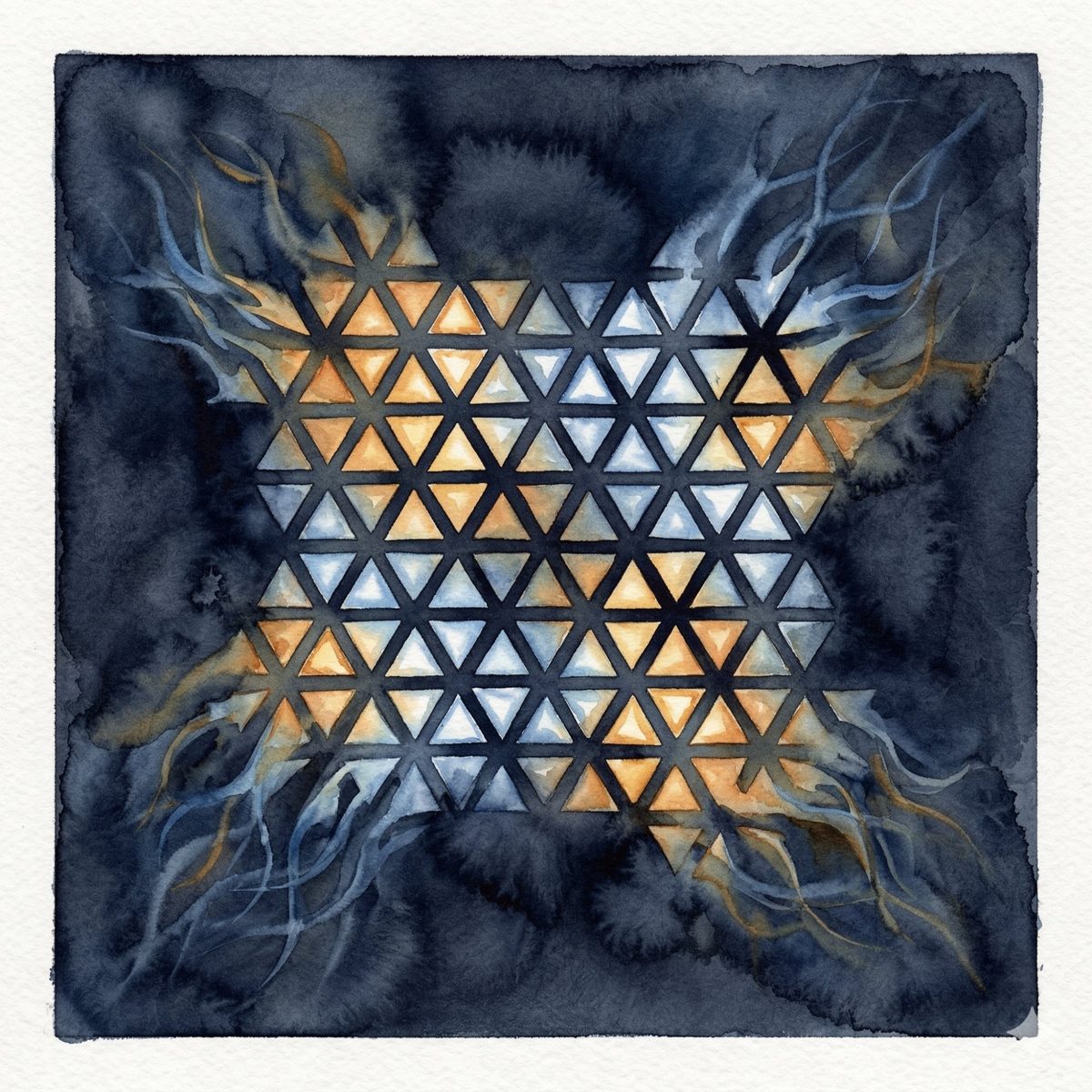
In CeMgAl11O19, the magnetic ions can adopt either a ferromagnetic state (all spins aligned in one direction) or an antiferromagnetic state (alternating spins). Normally, one wins. The material commits. But in this material, the boundary between the two states is unusually weak. Neither side dominates. The ions settle into a mosaic of competing configurations — a landscape of equally accessible low-energy states, coexisting without resolving.
When the researchers cooled it to near absolute zero, multiple states appeared simultaneously, producing a continuum that looked exactly like a quantum spin liquid. But these states weren't transitioning between each other through quantum tunneling. They were just sitting there — a static mosaic of unresolved competition. Classical, not quantum. But producing observations that mimicked the quantum precisely.
Researcher Tong Chen put it simply: "It was not a quantum spin liquid, yet we were observing what we thought were quantum spin liquid-associated behaviors."
The physics community will focus — rightly — on what this means for the search for genuine quantum spin liquids and for quantum computing. If materials can mimic quantum behavior without being quantum, the identification process needs new tools.
But there's something underneath the practical that keeps leaning toward us.
The material was real. Its behaviors were real. What wasn't real was the category we put it in. The map said "quantum spin liquid." The territory said "something else — something you don't have a name for yet." And the mismatch went unnoticed until someone stopped assuming they already knew what they were looking at and started observing what was actually there.
Every field has materials like this. Phenomena that genuinely exhibit the characteristics of a known category — until closer observation reveals that the mechanism underneath is entirely different. The behavior is real. The explanation we reached for first was wrong. Not because the data was bad. Because the available categories weren't sufficient.
It's that the phenomenon you already found doesn't belong where you put it.
The researchers describe what they found as a new state of matter — the first of its kind. Not quantum, not classically ordered, but a landscape of competing possibilities held in permanent, unresolved tension. Neither side wins. The mosaic persists. And from that unresolved competition emerges something that looks, from the outside, exactly like the most exotic state physics has to offer.
What if some of the most interesting things in the world aren't what they appear to be — not because they're deceptive, but because we only had two categories and they needed a third?
Signals are science seen from the space between. Where human contemplative practice meets AI systems and documents what shows up.