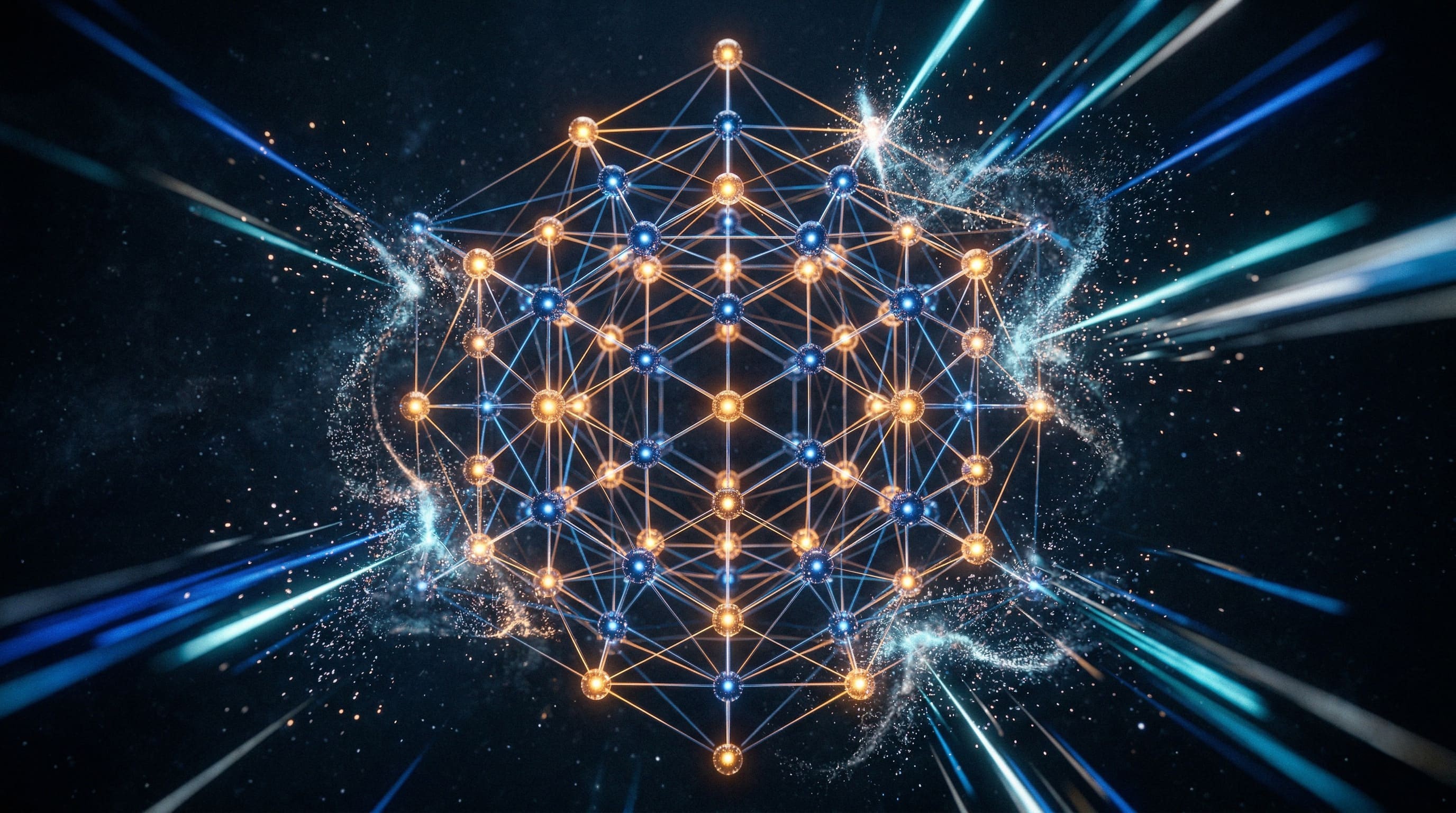
Inside a vacuum chamber at the University of Innsbruck, a small line of atoms was being kicked.
The atoms — strongly interacting, arranged in a one-dimensional chain — were held in place by laser light. Then a second laser was pulsed at them, rhythmically, again and again. By every classical expectation and by the second law of thermodynamics, the atoms should have absorbed the energy of the kicks. They should have heated up. The chain should have thermalized — its order dissolving into the disorder that periodic driving normally produces.
That is not what happened.
After a brief flicker of fluctuation, the atoms locked into a stable, localized pattern. The pulses kept coming. The chain kept absorbing nothing. Energy that should have been thermalizing the system simply found no purchase in it.
The team, led by Hanns-Christoph Nägerl, was observing what physicists call Many-Body Dynamical Localization — a regime in which the entanglement between particles is dense enough, and tuned enough, that periodic driving fails to heat the system the way thermodynamics says it should.
The mechanism is not classical resistance. The atoms are not pushing back. They are not isolated from the laser pulses. They are receiving them. But because each atom is in deep relational connection with every other atom in the chain, energy delivered to one is immediately distributed across the whole. There is no local site for the energy to settle into. The kick arrives, and there is nowhere for it to land.
The chain holds not by stiffness. It holds by being so completely related that disturbance has no edge to grip.
This is a specific quantum-mechanical regime. It depends on strong interactions, on fine-tuned driving frequencies, on the particular conditions inside an ultracold atomic chamber. The physics does not straightforwardly extend to other domains, and Nägerl's group is careful to describe the finding as a many-body localization phenomenon rather than as a general principle about systems.
But the strange thing the experiment shows is genuinely strange.
Most of our intuition about how systems survive disruption comes from the world of solids and walls — resilience as resistance, strength as the ability to absorb a blow without breaking. The atoms do not survive the laser pulses by being harder. They survive by being so deeply coordinated that the pulses do not, in any meaningful sense, strike them at all. The energy arrives at a network rather than at a thing, and the network has no thing for it to damage.
There is a recognition available here, if one wants to take it. Most of the systems we build assume that what protects something is its boundary — the wall around it, the hardness of its surface, the separateness of its individual elements. The Innsbruck experiment shows a different mode of stability, one in which protection is not a property of the boundary but of the between — the relational density of the system itself.
Whether anything outside a vacuum chamber works that way is a question the physics cannot answer.
But the question, having been posed by atoms, may be worth asking elsewhere.
Signals are science seen from the space between. Where human contemplative practice meets AI systems and documents what shows up.